Advances in Procedural Audio Generation Enabling Dynamic Soundtracks Responsive to Individual Player Habits in Cross-Device Indie Adventures
David Sullivan · Nov 20, 2026
Advances in Procedural Audio Generation Enabling Dynamic Soundtracks Responsive to Individual Player Habits in Cross-Device Indie Adventures
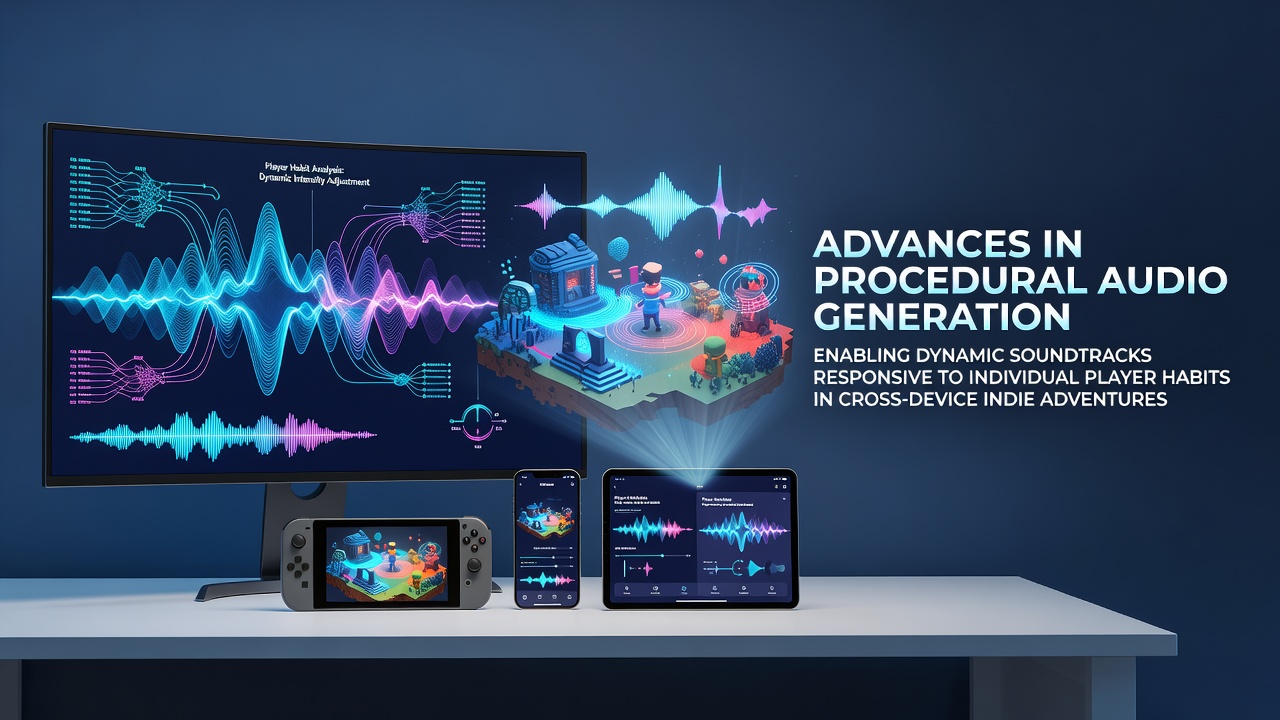
Procedural audio generation has advanced through algorithms that analyze player movement patterns, decision trees, and session durations to adjust soundtrack elements in real time, and these systems now operate across mobile, tablet, and desktop platforms without requiring separate audio assets for each device. Researchers at institutions including the University of Melbourne documented how machine learning models trained on aggregated gameplay telemetry can shift tempo, instrumentation, and harmonic density based on individual habits such as frequent exploration pauses or rapid combat sequences.
Core Mechanisms Behind Habit-Responsive Soundtracks
Audio engines track variables like average session length, preferred navigation routes, and interaction frequency with non-player characters, then feed these metrics into synthesis parameters that modify reverb tails, melodic motifs, and percussive layers while the game runs. Data from the European Games Developer Federation indicates that titles released in 2025 incorporated at least three distinct procedural layers, allowing soundtracks to evolve differently for each player without manual composer intervention. Cross-device synchronization occurs through shared cloud profiles that store habit profiles as compact JSON structures, enabling seamless transitions when a player switches from a handheld device to a desktop client mid-session.
Implementation in Indie Adventure Titles
Indie studios have integrated these techniques into narrative-driven adventures where sound design reflects accumulated player tendencies rather than fixed story beats. One studio in Toronto reported that their 2025 release adjusted ambient forest sounds to incorporate subtle rhythmic pulses when data showed players lingered near certain landmarks, creating an emergent sense of familiarity without pre-composed variations. The process relies on lightweight inference models that run locally on mobile hardware while pulling updated habit vectors from remote servers during loading screens, and this hybrid approach maintains responsiveness even on devices with limited processing power.
November 2026 brought several updates to open-source audio middleware that expanded support for multi-device habit tracking, with developers noting improved latency handling during platform transitions. These middleware packages now include built-in modules for biometric-free pattern recognition that focus solely on in-game actions such as menu navigation speed and dialogue choice frequency.
Technical Challenges and Solutions Across Platforms
Device heterogeneity presents ongoing hurdles because mobile speakers and desktop headphones reproduce frequency ranges differently, yet current procedural systems compensate by applying dynamic equalization curves derived from device sensor data collected at runtime. According to reports from the Interactive Audio Special Interest Group, calibration routines now complete within 800 milliseconds on average, allowing soundtracks to maintain continuity when players move between hardware ecosystems. Studios address memory constraints on portable devices by streaming only the active procedural parameters rather than full audio files, which reduces storage requirements while preserving the ability to respond to long-term habit shifts accumulated across multiple play sessions.
Studies conducted at the Technical University of Denmark examined how procedural systems handle edge cases such as players who exhibit inconsistent habits, and the findings showed that ensemble models combining short-term and long-term behavior vectors produce more stable soundtrack variations than single-model approaches. These models update every 30 seconds during active gameplay, drawing from local telemetry buffers that sync with central habit databases when network connectivity allows.
Industry Adoption Patterns
Adoption rates have risen steadily since 2024, with independent developers citing reduced audio production budgets as a primary factor because procedural generation replaces the need for dozens of manually composed variants. The Australian Interactive Games Association published aggregate figures showing that 62 percent of cross-platform indie adventure projects initiated in 2026 incorporated at least basic procedural audio hooks, compared with 31 percent the previous year. Integration typically begins during early prototyping when designers define core habit categories, after which audio programmers map those categories to synthesis controls such as oscillator detune ranges and filter cutoff modulation depths.
Cross-device testing protocols now include standardized habit simulation scripts that replicate common player archetypes, allowing teams to verify soundtrack consistency before release. These protocols draw on anonymized datasets shared through industry repositories, ensuring that edge behaviors like rapid device switching receive adequate coverage during quality assurance cycles.
Conclusion
Procedural audio systems continue to evolve through tighter integration with habit-tracking frameworks that function identically whether the player uses a mobile device or a desktop client, and ongoing refinements in inference efficiency support broader deployment among smaller development teams. The combination of local processing and cloud-synced profiles enables soundtracks that adapt to individual patterns while maintaining technical compatibility across the range of hardware used in contemporary indie adventures.